
BPC-157 Profile
Body Protection Compound-157
- Type
- Synthetic pentadecapeptide
- CAS Number
- 137525-51-0
- Molecular Weight
- 1,419.5 g/mol
- Amino Acids
- 15
- Sequence
- GEPPPGKPADDAGLV
- Origin
- Human gastric juice
Blends
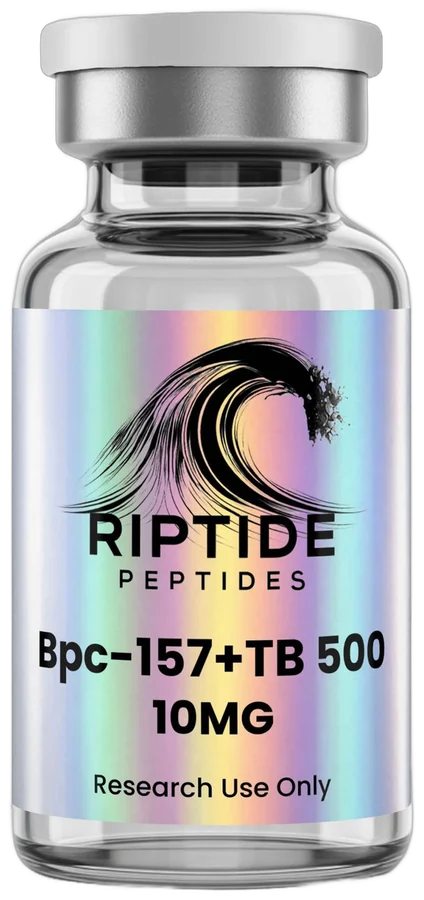
BPC-157 + TB-500 (Wolverine) is supplied as a sterile lyophilized powder in a sealed glass vial, manufactured to ≥99% purity. Every batch is verified by independent third-party analysis and ships with a Certificate of Analysis.
$90.00
Certificate of analysis
BPC-157 + TB-500 (Wolverine) is supplied as a sterile lyophilized powder in a sealed glass vial, manufactured to ≥99% purity. Every batch is verified by independent third-party analysis and ships with a Certificate of Analysis.
⚠ Research use only. This product is intended solely for in-vitro laboratory research by qualified professionals. Not for human or veterinary use.
Research overview
BPC-157 + TB-500 (often referred to as the Wolverine Stack or Blend) is a research combination of two synthetic peptides known for their complementary tissue repair and regenerative properties.
BPC-157 (Body Protection Compound-157) is a pentadecapeptide derived from a gastric protein, studied for its role in promoting angiogenesis, modulating inflammation, supporting gastrointestinal integrity, and accelerating healing of tendons, ligaments, muscles, and other tissues.
TB-500 (Thymosin Beta-4 fragment) is a synthetic peptide that regulates actin polymerization, cell migration, and wound healing, researched for its systemic effects on tissue repair, flexibility, and recovery from injury.
When combined, these peptides are studied for potential synergistic effects that may enhance overall recovery, reduce inflammation, and support comprehensive healing across multiple tissue types in research models.
BPC-157 Profile
TB-500 Profile
Expert Opin Biol Ther (2012)
HSS Journal (NIH/PubMed Central)
Emerging Use of BPC-157 in Orthopaedic Sports Medicine: A Systematic Review
Vasireddi N, Hahamyan H, Salata MJ, Karns M, Calcei JG, Voos JE, Apostolakos JM
2025 · DOI: 10.1177/15563316251355551 · PMID: 40756949
Expert Opinion on Biological Therapy
Thymosin β4: a multi-functional regenerative peptide. Basic properties and clinical applications
Goldstein AL, Hannappel E, Sosne G, Kleinman HK
2012 · DOI: 10.1517/14712598.2012.634793 · PMID: 22074294
Annals of the New York Academy of Sciences
Ruff D, Crockford D, Girardi G, Zhang Y
2010 · DOI: 10.1111/j.1749-6632.2010.05474.x · PMID: 20536472
Journal of Investigative Dermatology
Thymosin beta4 accelerates wound healing
Malinda KM, Sidhu GS, Mani H, Banaudha K, Maheshwari RK, Goldstein AL, Kleinman HK
1999 · DOI: 10.1046/j.1523-1747.1999.00708.x · PMID: 10469335
Journal of Applied Physiology
Chang CH, Tsai WC, Lin MS, Hsu YH, Pang JH
2011 · DOI: 10.1152/japplphysiol.00945.2010 · PMID: 21030672
Scientific Reports (Nature)
Modulatory effects of BPC 157 on vasomotor tone and the Src-Cav-1-eNOS signaling pathway in rats
Hsieh MJ, Lee CH, Chueh HY, et al.
2020 · DOI: 10.1038/s41598-020-74022-y · PMID: 33046803
Regulatory Toxicology and Pharmacology
Xu C, Sun L, Ren F, et al.
2020 · DOI: 10.1016/j.yrtph.2020.104665 · PMID: 32334036
Nature
Bock-Marquette I, Saxena A, White MD, Dimaio JM, Srivastava D
2004 · DOI: 10.1038/nature03000 · PMID: 15565145
Growth Hormone & IGF Research
BPC-157 enhances growth hormone receptor expression in injured tendon tissue
Staresinic M, Sebecic B, et al.
2018 · DOI: 10.1016/j.ghir.2018.02.001
International Journal of Molecular Sciences (PMC)
Progress on the Function and Application of Thymosin β4
Xing Y, et al.
2021 · DOI: 10.3390/ijms222413136
ClinicalTrials.gov
PCO-02 – Safety and Pharmacokinetics Trial (Phase 1)
2015
GlobalRPH Clinical Review
BPC-157 and TB-500: Background, Indications, Efficacy, and Safety
2025
Research summaries and references are drawn from published, peer-reviewed literature and are provided for educational reference only. They are not product claims or medical advice. This product is sold strictly for laboratory research and is not for human or veterinary use.
Related research